
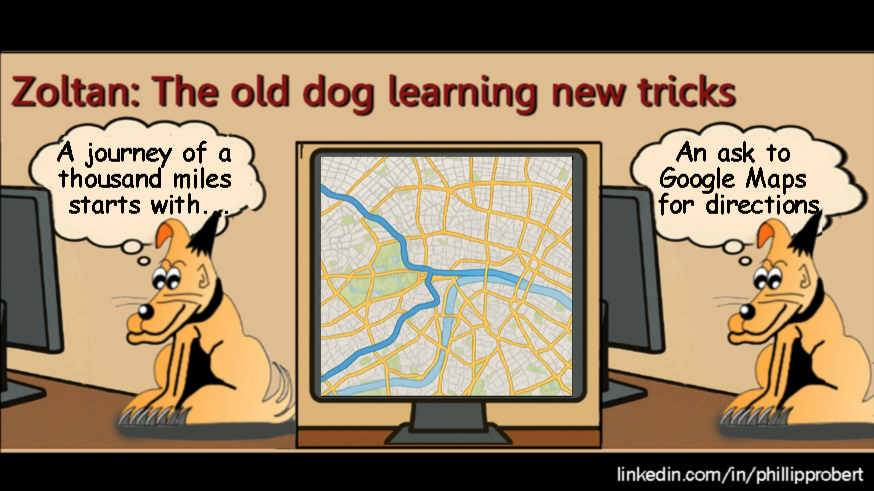
A journey of a thousand miles starts with… these days, an ask to Google Maps for directions.
This essay is going to cover a lot of topics, but they are all connected. Hold on…
This week, according to my local newspaper another HGV got stuck when the driver followed computer directions and ended up in a lane wholly unsuitable for a vehicle of 40 tonnes. Upon reading that, I thought to myself, “Oh, not again.”
It is a cliché that we now trust computers to direct us from A to B without checking their accuracy, but millions of us use these algorithms every day, because they are so easy and useful.
That’s not what this waffle is about.
We see the same dynamic with the adoption of AI to help with research and writing. Every single Large Language Model displays a caution print: “Hey, I can make mistakes.” Yet the adoption of these tools grows continuously.
Some companies and governments are so worried by this that we now see demands for warning labels, signposting that text might be synthetic, or dismissing content as “AI slop” before evaluating its actual substance.
That’s not what this waffle is about either.
My local newspaper recently announced that it is going behind a paywall. No more free web news. The printed weekly paper is now over £2.00. Every time the publisher increases the price, circulation drops. To counter that drop, they raise the price again. It is a familiar death spiral.
The accompanying website is, frankly, atrocious. Adverts clamour around the margins, interrupt the middle of paragraphs, and just when you think the story has concluded, you are met with row upon row of clickbait.
Don’t mistake this for a standard online rant. I have skin in the game. Not only did I design newspapers, but for a brief blip in time nearly 30 years ago, I helped design and produce some of the very first newspaper-based websites. My perspective comes with context.
Go2Birmingham was, by modern technical standards, an archaic website – built with HTML frames (ask grandad what those were) and managed without a modern content management system. Yet, compared to the sensory overload of today’s local news pages, it prioritised the reader.
And even that is not entirely what this waffle is about.
Newspapers live and die by circulation. Back in 1996, my Editor-in-Chief and I were reviewing the latest figures for the Merthyr Express. Sales were down compared to the previous year. What had changed? Nothing obviously measurable, until someone pointed out that during the exact same week the previous year, there had been a horrific local tragedy.
It turns out people lean into the drama. Except local news outlets don’t have high drama every week. Most days, it is the mundane, vital work of holding local councils accountable and reporting on community infrastructure. I deeply recognise the value of that work, the slow, unglamourous investigative journalism that exposes inefficiency and injustice.
Which brings us to LinkedIn.
Why do deep, analytical essays on professional networks get ignored while low-effort clickbait and engagement bait perform exceptionally well?
I have no insider insight into LinkedIn’s underlying code. (Wish that I did) What I do have is observational data: a feed increasingly dominated by quick-dopamine prompts like word puzzles, extreme hot-takes, and emotional performativity.
If your goal on a platform is to demonstrate critical thinking, structural analysis, and strategic communication to prospective clients or employers, gaming the system with trivial content feels entirely counterproductive.
Which, in turn, brings us back to AI.
Not the trope of whether an algorithm wrote this essay or not, nor Article 50, but the recent shift toward embedding sponsored placements and native advertising directly inside model responses.
The pattern
- The Route: We outsource navigation to algorithms because convenience outweighs critical friction.
- The Publisher: Local media replaces user experience with intrusive ads to cover falling revenues, driving away the audience that sustained it.
- The Platform: Professional networks optimise for immediate metrics over depth, drowning out substantive discourse.
- The Intelligence: AI tools move from pure utility to monetised distribution channels.
We are witnessing the exact same economic model metastasise across every digital medium: Convenience creates reliance -> Reliance builds distribution -> Distribution is monetised via distraction.
Where we go from here?
When systems prioritise automated monetisation over signal quality, the user experience degrades. So, what can we actually do about it, as workers, thinkers, and professionals?
- Maintain the friction: Do not switch off the critical layer. Whether driving a 40-tonne vehicle or reviewing AI-generated strategic reports, treat algorithmic output as a secondary input, not a final authority.
- Value the signal over the surface: If we want high-quality local reporting, thoughtful professional commentary, or reliable research tools, we have to actively reward depth. That means engaging with long-form thought leadership on platforms like LinkedIn, even when the algorithm and you might prefer a meme.
- Decouple value from impression counts: One hundred views from senior decision-makers who read your critical analysis are infinitely more valuable than a million impressions on a word puzzle. Write for the audience you respect, not the metrics that vanity tracks.
We began with a driver blindly trusting a dashboard map into a narrow lane. The hazard isn’t the technology itself, it is the passive surrender of our own judgment along the way. If we want digital spaces that reflect real expertise, we have to start paying attention to the road again.
Thank you for reading this
Zoltan is a three-panel cartoon that looks at some of the issues and absurdities of looking for work and the digital universe. The cartoon is then supported by an essay that looks into the issue, why this might be a thing and what we can do about it.
To be clear, these essays are NOT about the guy who is ranting about job searching because he can’t get hired or ‘woe is me’. They’re from the astute observer of any systemic dysfunction.
This essay blends intentional human curation with AI‑assisted support; all synthetic content is intentionally disclosed.
First on LinkedIn: Friday 23rd August, 2026