
We have spent the last few years waging a collective war on machine-generated text. We bemoan the robotic syntax, the predictable structural transitions, and the bloodless summaries that clutter our professional feeds.
So aggressive has the pushback been that social networks have even introduced explicit reporting mechanisms to flag automated clutter.
The underlying thesis was noble: if we could just filter out the synthetic noise, the rich, authentic hum of human wisdom would shine through.
Except that is not quite what happened.
Instead of elevated professional dialogue, we inherited a secondary pandemic: performative vulnerability, or what internet culture has accurately dubbed “cringe.”
Faced with the choice between generic machine text and a calculated, eight-paragraph confession about how dying one’s hair purple or turning 40 was a transformative act of public leadership, a growing number of professionals are quietly reaching a startling conclusion: At least the machine doesn’t ask me to validate its soul.
Understanding how we arrived at this binary, where our choices seem limited to mechanical slop or weaponised emotional intimacy, requires examining what modern platform architecture actually incentives.
The human-written posts currently causing widespread second-hand embarrassment are not accidental; they are algorithmic adaptations.
When algorithmic distribution models shifted to penalise generic corporate copy, creator coaches and personal branding gurus stepped in with a straightforward solution: share the “behind-the-scenes”. Share the mess. Be vulnerable. Convert your daily life, your minor identity crisis, your corporate transition, or a historical trauma into a “lesson learned” with a neat, five-point summary.
The issue with this playbook is not the sharing of human emotion or personal history; it is the deliberate commodification of it.
- The “Vulnerable” Hook – “I cringe posting this…”
- The Personal Quirk – Pink hair, turning 42, corporate job change
- The Manufactured Epiphany – Getting a haircut is public service
- The Aggressive Call to Action – “What’s that for you? Share it.!”
When an author starts a post by admitting they cringe while posting, or frames basic self-expression as a spiritual awakening that “allows others to find their joy,” the audience immediately senses the dissonance.
It is human content, yes, but it is engineered using the exact same structural template as a direct response sales letter.
This is branded authenticity: an attempt to manufacture trust by treating vulnerability as a lead-generation strategy. And because it comes wrapped in the explicit demand for empathy, it feels far more invasive than a piece of obviously synthetic text.
To navigate a professional network today is to constantly dodge three distinct categories of content, each failing the reader in a different way:
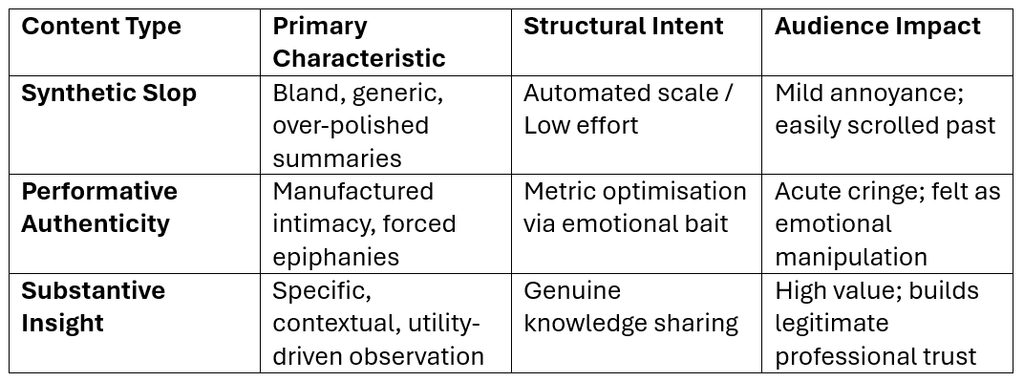
Synthetic content lacks soul, but performative content uses soul as transactional currency. One is empty; the other is deeply cynical.
Why does performative human content often feel worse than a completely fake paragraph written by a server in Ohio?
- The Emotional Shakedown: Synthetic text makes no demands on your emotional bandwidth. It exists, it is dull, and you scroll past. Performative human content, however, uses open-ended peer-pressure (“Go on. Dare ya!”) to corner the reader into holding space for someone’s branding exercise.
- The Heroic Framing: Almost every piece of “cringe” casts the writer as the protagonist in a microscopic drama. Taking a standard corporate role becomes a selfless mission to “be the voice of the founder.” Dyeing hair becomes an act of public philanthropy. Setting a basic business boundary becomes an epic tale of moral courage. The scale of the rhetoric rarely matches the modest reality of the event.
- The Erasure of Professional Boundaries: Professional networks were originally built on the exchange of domain expertise, context, and practical insight. The complete erosion of the line between private therapy and B2B marketing hasn’t made platforms more human, it has just made them deeply uncomfortable.
The altern ve to robotic text is not oversharing our personal trauma for impressions. There is a vast, productive middle ground that modern professional communication seems to have forgotten: substantive, professional utility.
We do not need to choose between an AI-generated listicle and a stranger’s performative journal entry. We can choose posts that offer specific insights, real trade-offs, clear technical analyses, and genuine professional observations—delivered without a cinematic backstory or an emotional tax.
If we want to fix the state of our professional feeds, the solution isn’t just flagging the bots. It is holding human writers to a higher standard: one where dignity is preserved, boundaries are respected, and expertise doesn’t require a public confession.
First: LinkedIn September 1, 2026