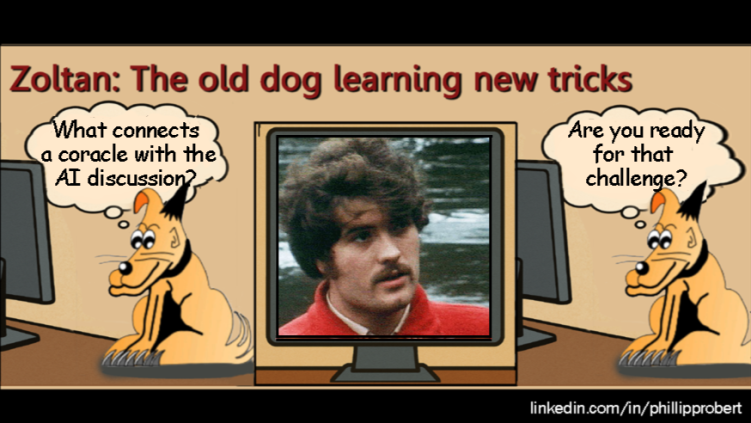
His name is Geraint Pillock, and for some, he is the greatest Welshman who ever lived. That puts him in stiff competition with Tom Jones, Gareth Edwards, and Rob Brydon, but Geraint holds his ground.
Never heard of him? Now’s your chance.
Geraint Pillock was a cult-favourite comedic character created by John Sparkes for the classic HTV Wales sketch show Barry Welsh is Coming. He was an eccentric, stone-faced coracle enthusiast best known for answering every news reporter’s question with his legendary catchphrase:
“Mainly because it’s a challenge for me, a challenge for the coracle, and a personal challenge for me.”
The genius of Geraint Pillock was that he wasn’t entirely fictional. He was portrayed by Denzil Davies – a real-life former games teacher, rugby coach, and genuine coracle master who fully embraced the bit, even writing a book under the alias.
Denzil is a proper Welsh hero. Why? Because back in 1973, he actually paddled an authentic, hand-woven coracle straight across the English Channel. It was a terrifying, absurd, and brilliant feat of endurance. And it was a proper challenge – rightly so.
Which brings us, naturally, to AI watermarking.
The layers of pedantry
Let’s stop and celebrate Denzil’s channel crossing. It was fantastic. But if modern digital compliance officers had been waiting for him on the beach at Calais, the conversation wouldn’t have been about his heroic stamina. It would have been an audit.
“Excuse me, Mr Davies, but did you weave the hazel hurdles for this coracle yourself?”
Well, yes, he probably did, the man is a certified coracle genius.
“Right. But did you paddle the boat all the way from Fishguard to Dover before starting the crossing, or did you put it on a trailer? Did you harvest that tar yourself, or did you buy a tin from the local B&Q? We need full material provenance before we can certify this as an Authentic Welsh Heroic Feat.”
This is the exact level of pedantry we have arrived at in 2026.
With Anthropic, OpenAI, and every tech titan scrambling to add imperceptible watermarking and metadata tracking to satisfy Article 50 of the EU AI Act, we have officially entered The Bureaucracy of the Boat.
Instead of looking at the crossing, we are auditing the timber. Instead of judging whether a piece of writing is insightful, funny, or useful, we are demanding a full forensic bill of materials.
So where does the credit sequence end?
If we carry this obsession with “provenance” to its logical conclusion, every routine email, blog post, and LinkedIn article will soon require a Hollywood-style end credit sequence:
[ THIS ESSAY WAS PRODUCED BY: ]
- Written & directed by: Phillip Probert
- Prose Cleanup & Syntax Formatting: Large Language Model (v4.5)
- Punctuation Consistency: Mr. Edwards (English Teacher, 1988) – For instilling a lifelong obsession with the Oxford Comma
- Caffeine Logistics: Nescafé Gold Blend
- Grid Layout Inspiration: Newcastle Evening Chronicle (1998)
- Feline distraction: Ollie, Luna and Zoella
Where does it stop?
If I use an LLM to tidy up a sentence, I am required by policy to disclose the machine. But do I need to disclose that Mr Edwards taught me how to use a semi-colon?
Do I need to credit the spellchecker that caught my typos in 2004?
When we insist that every tool used along the way must be tagged, watermarked, and declared by default, we aren’t serving transparency. We are just creating noise.
A personal challenge for the coracle
Yes, I use AI tools to research, outline, clean up, and sub-edit – It’s my job. I also write personal, unvarnished essays for small audiences where I build the entire coracle out of raw wood with my own hands, imperfections, rough edges, and all.
(I also write novels in crayon – and If you know that reference, you know)
Both ways of working are valid. But treating a light copy-edit from an LLM as if it’s a synthetic forgery misses the entire point of human effort.
Denzil Davies didn’t cross the English Channel to prove he manufactured the tar on his boat. He did it because he wanted to push a little woven basket through rough open waters. The achievement was in the navigation, the intent, and the sheer audacity of trying it. After-all, it had been done before
So, should AI content be watermarked by default?
If you’re filing a legal brief or publishing high-stakes news, fine, check the receipts.
But for the rest of digital life, let’s stop auditing the paddle and start reading the horizon.
After all, why do we write, prompt, edit, and publish in the first place?
Mainly because it’s a challenge for us, a challenge for the AI, and a personal challenge for us.
Thank you for reading this
Zoltan is a three-panel cartoon that looks at some of the issues and absurdities of looking for work and the digital universe. The cartoon is then supported by an essay that looks into the issue, why this might be a thing and what we can do about it.
To be clear, these essays are NOT about the guy who is ranting about job searching because he can’t get hired or ‘woe is me’. They’re from the astute observer of any systemic dysfunction.
First: LinkedIn August 21, 2026