
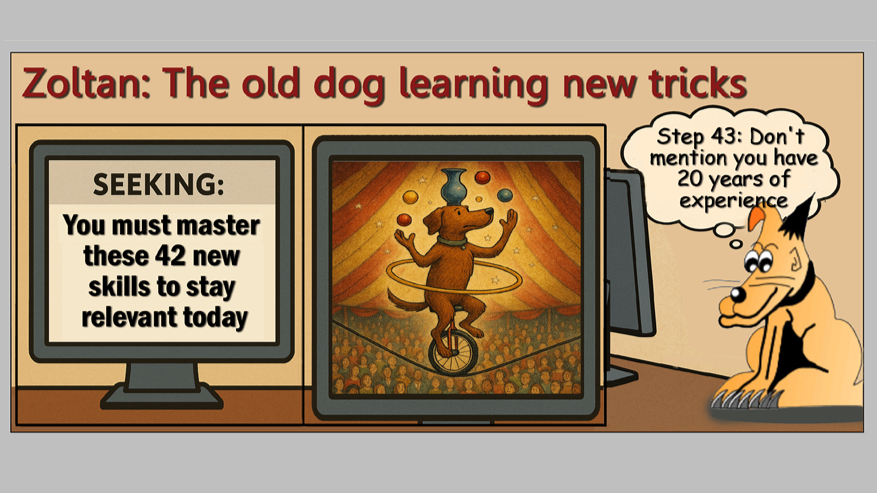
Walk into any career advice corner of the internet and you’ll be hit with the same message: constant reinvention. Master Python, learn blockchain, get certified in AI, pivot to TikTok marketing, become a growth hacking ninja rockstar unicorn evangelist. The implication is clear – if you’re not frantically upskilling every month, you’re destined for professional obsolescence.
The carousel of “essential” skills spins faster each month. Yesterday’s must-have certification is today’s outdated methodology. The advice on LinkedIn comes thick and fast: “Professionals over 40 MUST embrace these 12 emerging technologies!” “Is your skillset pandemic-proof?” “Why your 20 years of experience means nothing without these new competencies!”
Hey, we get it, learning is an essential life-skill.
So, you dutifully sign up for courses. You get your certificates. You learn the buzzwords. You update your LinkedIn profile with all the shiny new acronyms.
Then you apply for jobs.
And then get nowhere.
Here’s where it gets interesting: while everyone’s being told to learn 42 new skills to “stay relevant,” many experienced professionals aren’t progressing through hiring processes. Organisations often prioritise “fresh perspectives” and “digital natives” – candidates who can “grow with the role.”
There’s a disconnect here. Companies are investing heavily in upskilling messaging while potentially overlooking talent that already has deep institutional knowledge and proven problem-solving abilities.
The fascinating part? Many of these “essential” new skills are evolutions of approaches experienced professionals have been using for years. Agile methodology builds on iterative development principles. User experience design is fundamentally about not making things confusing for customers. AI data-driven decision making is paying attention to what works – with better tools.
The market seems to be asking people to get certified in concepts they’ve been applying successfully for years.
What’s the opportunity here?
Smart organisations are finding ways to bridge this gap and get the best of both worlds:
- Value experience as risk mitigation: Seasoned professionals have pattern recognition that prevents expensive mistakes. They’ve seen market cycles, technology transitions, and organisational changes before.
- Combine experience with fresh approaches: Rather than choosing between experience OR innovation, the most successful teams blend institutional knowledge with new methodologies.
- Focus on outcomes, not credentials: Some companies are shifting from “must have certification in X” to “must have delivered results using X principles” – recognising that execution matters more than coursework.
- Create mentorship structures: Organisations pairing experienced professionals with newer talent are seeing accelerated learning and better knowledge retention across teams.
- Look beyond age-homogeneous hiring: Diverse teams (in all dimensions, including age) consistently outperform homogeneous ones in complex problem-solving scenarios.
This creates opportunities for experienced professionals who can demonstrate both deep expertise and adaptability – professionals who can translate between “how we’ve always done it” and “how we need to do it now.”
For experienced professionals (Old dogs)
- Position your experience strategically: Frame your years as pattern recognition and risk mitigation, not just tenure. “I’ve seen this type of challenge before and know the pitfalls to avoid.”
- Show adaptability through examples: Don’t just list new skills you’ve learned; demonstrate how you’ve successfully adapted to change throughout your career. Tell stories of transformation, not just transaction.
- Network with purpose: Your decades in the field mean you have connections across the industry. Use warm introductions rather than cold applications – relationships often matter more than resumes.
- Target organisations with complex challenges: Established companies facing transformation or crisis need people who’ve navigated similar situations before. Look for problems that require wisdom, not just energy.
- Consider hybrid approaches: Consulting, fractional roles, or project-based work can let you prove value before organisations commit to full-time hires. Sometimes showing is more powerful than telling.
There’s clearly a market inefficiency when organisations simultaneously demand constant learning while not fully utilising their most experienced learners. But recognising this disconnect creates opportunities for both professionals and the organisations smart enough to bridge it.
The companies that figure out how to blend deep experience with fresh approaches – those are the ones that tend to navigate complex challenges most successfully.
After all, the most effective way to teach an old dog new tricks is to recognise that the old dog already knows quite a few useful ones.
First: LinkedIn – September 1, 2025