
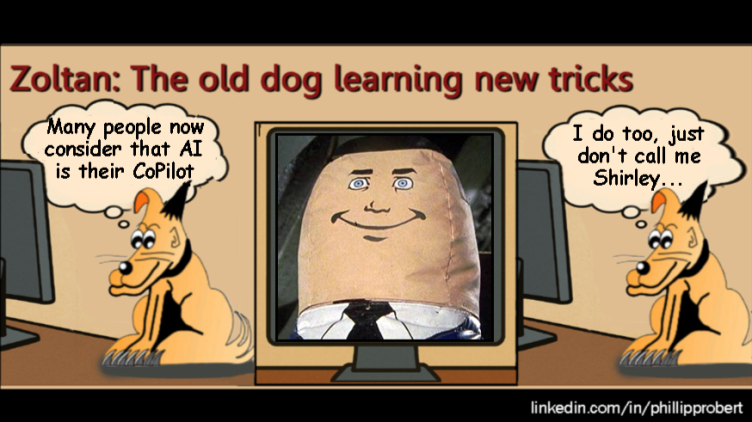
I was responding to a survey on the adoption of AI in the workplace. After completing the standard multiple-choice questions about daily usage metrics and primary use cases, there was a final open box asking for a summary of my thoughts.
What I wrote was this:
When people ask whether AI is actually worth using, I often think of the “Miracle on the Hudson.”
Captain Chesley “Sully” Sullenberger safely landed US Airways Flight 1549 on the Hudson River after a bird strike disabled both engines. Most people remember Sully, but there were two pilots on that flight deck. First Officer Jeff Skiles played a critical role, managing checklists, executing emergency procedures, gathering vital data, and helping make sense of a rapidly deteriorating situation.
AI reminds me of that relationship.
I am still the captain. I make the final decisions, apply hard-earned experience, and remain fully accountable for the outcome. But AI can act as a remarkably capable co-pilot: helping organise thoughts, challenging assumptions, summarising complex information, exploring options, and reducing cognitive load when things get overwhelming.
The value isn’t that it replaces human expertise. The value is that it helps experienced people think, learn, and communicate more effectively.
So far, so good. It sounds balanced, professional, and perhaps a touch idealistic.
However, if we genuinely start treating AI as a synthetic co-worker or daily partner, we need to talk about the troublingly predictable path ahead.
Just like any human partnership, a relationship with AI follows a distinct lifecycle, one that mirror the familiar stages of human relationships:
- Excitement & Curiosity: You’re intrigued. You test its limits, think about how to use it constantly, and want to explore its capabilities.
- Attraction & Infatuation: The utility intensifies. You idealise its speed and feel a strong pull to route every task through it.
- Connection & Bonding: Trust grows. It handles complex workflows, and the reliance begins to feel secure and routine.
- Reality / Adjustment: The initial honeymoon period settles. System boundaries and subtle flaws become noticeable.
- Commitment & Deeper Intimacy: You accept the quirks, build shared routines, and weave the tool into your core daily output.
- Comfort & Stability: The interaction feels safe and familiar. Novelty fades into quiet efficiency.
- Disinterest / Disengagement: The friction sets in. You realise the system isn’t always being truthful. Output grows formulaic, lazy, or flat-out incorrect, and the effort to correct it starts outstripping the time saved.
- Frustration & Conflict: Unmet expectations accumulate. You find yourself fighting with prompts, double-checking every single fact, and resenting the errors you subconsciously knew were possible all along.
- Decision Point: You either adapt how you use it, accept its hard limitations, or abandon it for manual work.
- Detachment: Emotional investment drops, reliance disappears, and you move forward on your own terms.
Most of us sprint through Stages 1 to 6, enjoying the seamless efficiency of their new digital partner.
Then they slam straight into Stage 7.
You suddenly catch the model hallucinating a citation, making up a statistic, or confidently outputting a dead-end direction. You realise that while the system was honest about its flaws from day one, wearing its small print “AI can make mistakes” disclaimer like a badge, you subconsciously chose to ignore it because the convenience was so intoxicating. You start blaming the tool for the very shortcuts you agreed to take.
Disinterest doesn’t necessarily mean the relationship is dead. Long-term partnerships naturally cycle through periods of excitement, calm, frustration, and renewed distance. The defining factor is whether there remains genuine curiosity, critical oversight, and a willingness to continually manage the relationship.
Which brings us right back to the flight deck.
It is easy to call an algorithm a “co-pilot” when the weather is clear, the flight plan is simple, and the routine is smooth. But real co-pilots don’t just generate text; they cross-check instruments, call out errors, and stay grounded in reality when the engines fail.
If our AI co-pilot starts hallucinating the altitude or quietly pointing us toward the trees, the responsibility never shifts to the instrument panel. The pilot-in-command still has to keep their hands on the yoke, look out the window, and fly the plane.
And just don’t call be Shirley
Thank you for reading this
Zoltan is a three-panel cartoon that looks at some of the issues and absurdities of looking for work and the digital universe. The cartoon is then supported by an essay that looks into the issue, why this might be a thing and what we can do about it.
To be clear, these essays are NOT about the guy who is ranting about job searching because he can’t get hired or ‘woe is me’. They’re from the astute observer of any systemic dysfunction.
This essay blends intentional human curation with AI‑assisted support; all synthetic content is intentionally disclosed.
First on LinkedIn: August 23, 2026